
When a prospect asks ChatGPT, Perplexity, Gemini or Google's AI Overviews who to call, the answer is built from what those tools can read and confirm about your firm. Your website is the main source: page titles, a page for each service, named people with credentials, plain answers, structured data, and facts that match your listings elsewhere.
Most older firm sites offer a logo, a page titled "Home," a list of services and a phone number. That isn't enough for an AI to describe you, so it describes someone else.
The fix isn't a special "AI file." It's writing down what you already know, where a machine can read and check it. Here's what AI tools look for, what older sites leave out, and what to fix first.
What happens when a prospect asks AI who to call?
The AI tries to give a short answer it can stand behind, and it can only use facts it can find and cross-check.
Picture the question: "Who's a good CPA in Arlington for a construction company?" A search page used to hand back ten links. An AI answer names a few firms, gives a line on each, and links to its sources. Google says its AI Overviews and AI Mode may use a "query fan-out" technique, running several related searches across subtopics and sources to build one response (Google Search Central).
That changes the owner's math. A good CPA, law or advisory client often stays for years, so one missed introduction costs a lot. And if you're not on the short list, you never learn the call didn't come.
The AI isn't judging whether you're good. It can't. It's judging what it can confirm.
What can an AI actually confirm about your firm?
Five things: who you are, what you do, where and for whom, who does the work, and whether other sources agree. Everything else is your opinion of yourself, and an AI has little reason to repeat it.
| What the AI needs | Where it reads it | What older sites often show |
|---|---|---|
| Who you are | Page titles, home page text, organization structured data | A title that says "Home" |
| What you do | A page for each service that opens with a plain answer | One "Services" page with a bullet list |
| Where, and for whom | Address, service area and client types, written in the text | An address in the footer, sometimes out of date |
| Who does the work | Bios with roles, credentials and license details | Bios in a PDF brochure, or none at all |
| Whether others agree | Google Business Profile, directories, public license records | A different suite number or phone number on each |
Compare two sentences. "We provide trusted, client-focused accounting solutions" gives an AI nothing to repeat. "We do bookkeeping, payroll and tax returns for construction subcontractors in Arlington and Grand Prairie" answers the prospect's question in one line. The second one is easier for a person to believe, too.
What does an older firm website leave out?
Mostly the specifics. The firm knows them. The site never wrote them down.
Take an example Arlington CPA firm. It's made up, but its gaps are common. Six people, two partners, twenty years of construction clients. Its site:
- Titles the home page "Home." Google's own guidance tells site owners to avoid vague titles like that (Google Search Central).
- Lists fourteen services on one page, so no page answers "CPA for construction companies."
- Keeps the partners' bios in a PDF brochure, with no license details.
- Still lists a partner who retired.
- Shows a suite number that doesn't match its Google Business Profile.
None of these is a technical failure. Each is a fact an AI could have used and didn't get.
What should you fix first?
Start with access and facts, then pages, then markup. The cheapest fixes come first.
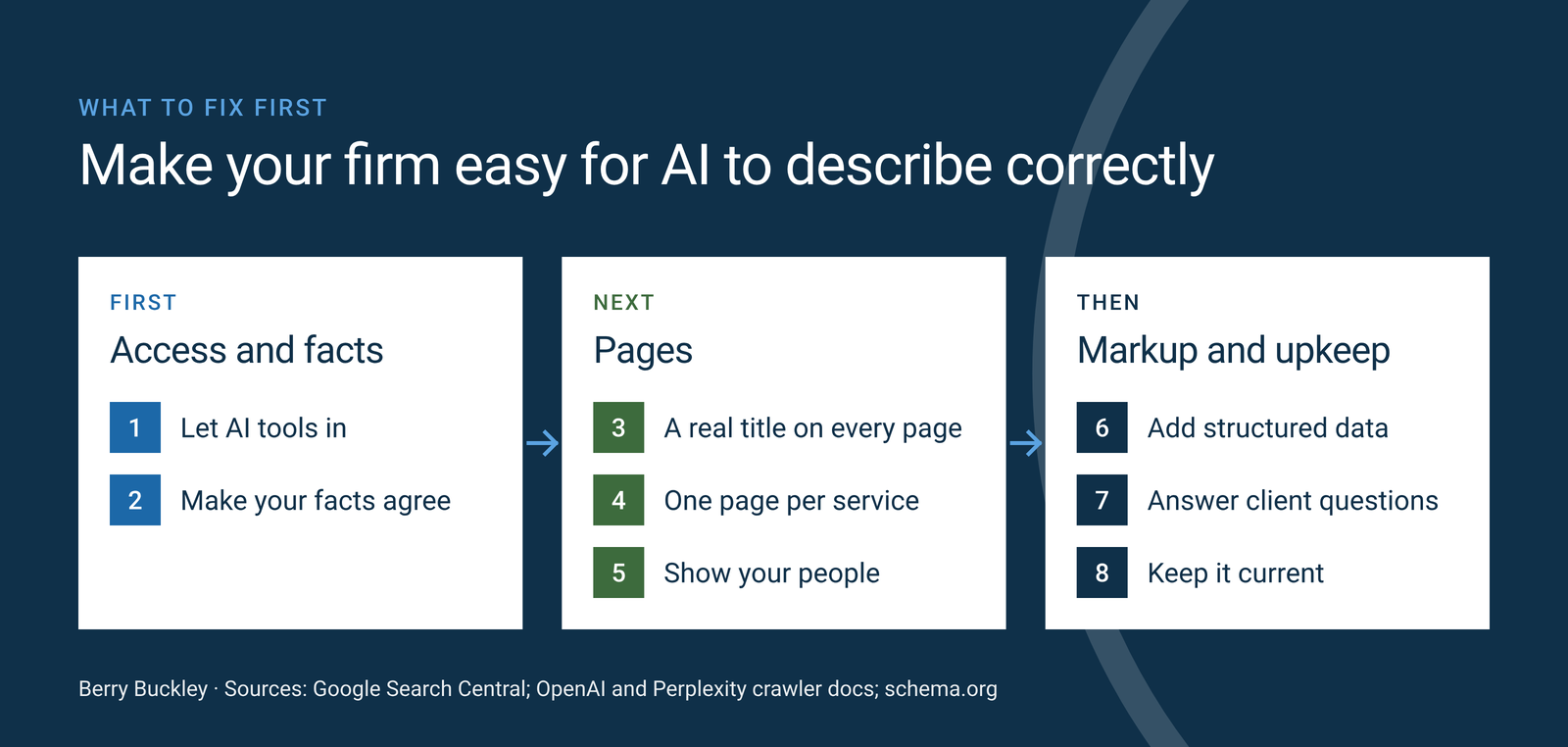
- Make sure AI tools can get in. Ask whoever runs your site to check robots.txt and any bot blocking at your host. Google lists crawling allowed "in robots.txt, and by any CDN or hosting infrastructure" as a basic for its AI features. Know which bot does what: OpenAI says sites that block OAI-SearchBot won't be shown in ChatGPT search answers, while GPTBot covers model training (OpenAI). PerplexityBot surfaces sites in Perplexity's results (Perplexity). Opting out of training can be a sound choice; blocking search by accident isn't.
- Make your facts agree everywhere. Use the same name, address, phone and hours on your site, your Google Business Profile and your directory listings. Google says businesses with complete and accurate information are more likely to show up in local results (Google Business Profile Help). An AI that finds two addresses has a reason to doubt both.
- Give every page a real title. "Tax Services for Construction Companies in Arlington" tells a machine what the page is about. "Home" doesn't.
- Give each main service its own page, and open with the answer. Say who it's for, what's included, where you work and how to start, in two or three plain sentences at the top. Keep it in text, not images or PDFs; Google asks for important content "in textual form."
- Show your people. List each person's role, credentials and practice areas, and link to the public record where one exists, such as the Texas State Board of Public Accountancy license lookup, the State Bar of Texas directory, or the SEC's Investment Adviser Public Disclosure site. Google asks whether it's "self-evident to your visitors who authored your content" (Google Search Central).
- Label it with structured data. Schema.org has types that fit these firms: AccountingService, LegalService and FinancialService, plus Person with hasCredential and sameAs links to your profiles. Google says it uses structured data to understand a page and the "people, books, or companies" in it (Google Search Central). The markup has to match what the page says.
- Answer the questions you hear every week. Short answers, in your words, on the pages where they belong: "Do you work with S corporations?" "Is the first meeting free?"
- Keep it current. Take down people who've left. A stale page is a conflicting fact.
Three checks you can do today, without a developer
- Ask ChatGPT and Perplexity the question your best client asked before hiring you. Are you named? Which pages are cited? Our What does AI say about your business? page runs this check for you.
- Do the address and phone on your site match your Google Business Profile?
- Read the browser-tab titles on your five main pages. Does each say what the page is about?
Isn't this just SEO with a new name?
Mostly, yes, and that's good news. Google says SEO best practices remain relevant for AI Overviews and AI Mode, and that "there are no additional requirements" to appear in them (Google Search Central). Be wary of anyone selling a secret AI package.
What's different is who reads the result. A ranked link lets a prospect visit your site and judge. An AI summary judges first, in a sentence or two, from whatever it could confirm. Gaps that used to cost you a click can now cost you the mention.
No one can promise you'll be named. What you control is whether your firm is easy to describe correctly.
Do professional advertising rules apply to these answers?
Yes. Plain answers on your site are still communications about your services. For Texas lawyers, the entire firm website must comply with Rules 7.01 and 7.02 (State Bar of Texas). Texas CPAs can't make false or misleading claims about their services (22 Tex. Admin. Code §501.82). SEC-registered investment advisers have the SEC marketing rule. The fixes above are specific, checkable facts, not superlatives, but run new copy past whoever reviews your advertising. We don't give legal or compliance advice.
How do we handle this for our own site and for clients?
When we rebuilt berrybuckley.com in October 2026, we built these checks into every change: page titles and the structured data search engines read are checked on a laptop and a phone before Paul approves anything (How we rebuilt our own website).
Our Website Agent does the same for client firms: titles, descriptions, structured data and alt text on every page, plus a check of what ChatGPT, Gemini and Perplexity say about the firm (more on AI search). You run the site by telling the agent what to change, and nothing goes live until you approve it.
If you want to know what your site is telling AI today, start with a free First Agent Audit. It covers your website, and you'll get a written brief that says what to fix first, whether or not we're the right fit.
Frequently asked questions
Does my firm need a new website to show up in AI answers?
Not always. Most of the checklist is edits to the site you have. A rebuild makes sense when your platform makes those edits hard.
Do I need an llms.txt file or special AI markup?
Google says you don't need new machine-readable files, AI text files or special schema to appear in AI Overviews or AI Mode. We keep an llms.txt on our own site, but it isn't where we'd start.
If I block AI bots, will ChatGPT stop mentioning my firm?
It depends on which bot. OpenAI says blocking OAI-SearchBot keeps a site out of ChatGPT search answers, though it can still appear as a navigational link. Blocking GPTBot opts you out of model training, and OpenAI treats the two settings separately. Google says its Google-Extended setting doesn't affect inclusion in Google Search, though it does govern use for grounding answers in Gemini Apps.
Can anyone guarantee my firm gets cited by AI?
No. Google says indexing and serving aren't guaranteed even when a page meets every requirement.
How do I see what AI says about my firm right now?
Ask ChatGPT, Perplexity, Gemini and Google what your clients ask, like "estate planning attorney in Plano." Or try our AI check.
An AI won't take your word for it. Give it something to check.
Sources
- Google Search Central, AI features and your website
- Google Search Central, Influencing your title links in search results
- Google Search Central, Creating helpful, reliable, people-first content
- Google Search Central, Introduction to structured data markup
- Google Search Central, Google's common crawlers (Google-Extended)
- Google Business Profile Help, Tips to improve your local ranking on Google
- OpenAI, Overview of OpenAI crawlers
- Perplexity, Perplexity crawlers
- Schema.org: AccountingService, LegalService, FinancialService, hasCredential, sameAs
- State Bar of Texas, Texas Disciplinary Rules of Professional Conduct, Rules 7.01–7.04
- 22 Tex. Admin. Code §501.82, Advertising (Texas State Board of Public Accountancy)
- U.S. SEC, Investment Adviser Marketing (Release IA-5653)