
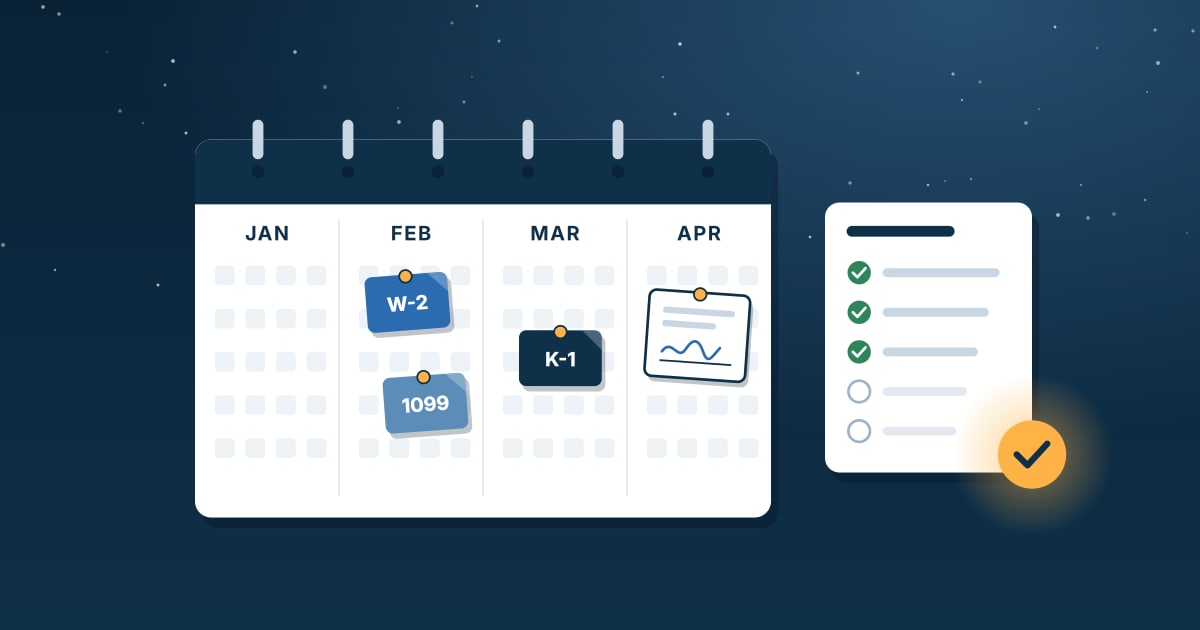
The bottleneck in a CPA firm's tax season usually isn't the tax work. It's the chase for W-2s, 1099s, K-1s and signed forms. That chase is routing, not judgment, so it is a good first job for an AI agent: send the reminder, confirm what came in, flag what's missing, and hand the CPA only the questions that need a CPA.
The calendar makes the case. Employers have until February 1, 2027 to get 2026 W-2s to employees. Brokers have until mid-February for most 1099-Bs. Calendar-year partnerships have until March 15, 2027, the day their own return is due, to issue K-1s, and later if they extend. Your April 15 deadline sits on top of all three.
So the chase isn't one email in January. It's a schedule. November is when you build it.
Why is the document chase the real tax-season bottleneck?
Nothing real happens on a return until the documents are in. A return missing one 1099 gets opened, parked and opened again. Across a client list, that isn't a skill problem. It's a queue.
The IRS says more than half of taxpayers use a tax professional to prepare and file (IRS, IR-2026-12). For those clients, the document set is your raw material. You can't speed up the work while the raw material arrives in pieces through March.
Look at what the chase actually takes:
- Knowing what each client sent last year.
- Asking for this year's version at the right time.
- Noticing what arrived.
- Asking again, by name, for what didn't.
- Answering "I already sent that."
- Spotting when something new shows up.
Only the last one needs a CPA. The first five are routing. When they land on preparers and partners between returns, that's capacity you lose in the weeks you need it most.
When are W-2s, 1099s and K-1s due to clients in 2027?
For tax year 2026, W-2s and 1099-NECs are due to recipients by February 1, 2027, most brokerage 1099-Bs by February 16, and partnership K-1s by March 15 for calendar-year partnerships, later if they extend. Each document exists on its own date, so each needs its own ask.
| Document | Who issues it | Due to your client (tax year 2026) |
|---|---|---|
| Signed engagement letter | Your firm | Before work starts (your policy) |
| Form W-2 | Employer | February 1, 2027 |
| Form 1099-NEC | A business that paid a contractor | January 31, which moves to February 1, 2027 because the 31st is a Sunday |
| Form 1099-B | Broker | February 15, which moves to February 16, 2027 because the 15th is Presidents' Day, a federal holiday |
| Schedule K-1 (Form 1065) | Partnership | By the partnership's return due date: March 15, 2027 for calendar-year partnerships, or as late as September 15, 2027 if it extends on Form 7004 |
| Form 8879 (e-file signature) | Your firm, signed by the client | Before you transmit the return |
Sources: IRS instructions for Forms W-2/W-3, 1099-MISC/1099-NEC, Certain Information Returns and Form 1065; Treas. Reg. 1.6031(b)-1T(b); IRS Form 8879. A due date that falls on a weekend or legal holiday moves to the next business day.
A reminder in early January asks for documents that don't exist yet. Ask for a W-2 on January 10 and the honest answer is "I don't have it." Ask three times before it exists and you teach the client to ignore you. Ask the day after it's due, by employer name, and you're asking for something the client can actually find.

What does a first agent actually do in the document chase?
A document-chase agent runs the routing on your tools, from your list: it asks for each document once it exists, confirms what arrived, names what's still out, and sends every judgment call to a person.
- Start from last year's list. Last year's return is this year's checklist. Each client's employers, brokers and partnerships are already in your files.
- Ask at the right time. Engagement letters first. W-2s and 1099-NECs after February 1. Brokerage forms after mid-February. K-1s after the partnership's due date.
- Confirm what came in. When the checklist shows an item received, the agent thanks the client and names what's still out.
- Flag what's missing. One short list each morning: who's complete, who's waiting on what, who has gone quiet.
- Handle routine replies. "I already uploaded it" gets a status check and an answer. "My employer hasn't sent it" gets a later reminder.
- Chase the last signature. Your firm needs the client's signed Form 8879 before it transmits the e-filed return (IRS Form 8879).
Hypothetical example. The firm and client are made up to show the pattern. They are not a real client or result.
A four-person firm in Plano. One client's file lists two W-2s, a 1099-B and a K-1 from a family partnership. On February 2 the agent asks for both W-2s by employer name. One arrives February 4; the agent thanks the client and names the one still out. On February 17 it asks for the brokerage form. It doesn't ask for the K-1 until March 16.
On March 18 the client writes: "Also, I sold the rental house this year." The agent doesn't answer. It flags the note for the partner, because a sale is new scope, and new scope is a conversation about the work and the fee.
Where does the CPA's judgment start?
Received isn't the same as complete. The agent can tell you a file arrived against the "W-2" line. A person decides whether it's the right W-2, whether the numbers make sense, and whether anything changed.
These always go to a person: anything new in the client's life (a job, a sale, an entity, a move), any question that starts "Should I…", a form the issuer won't send, fees, scope, extensions, anything about the return itself, and any message that sounds upset or urgent.
The agent tracks who owes what, and when. People decide what it means.
What should a document-chase agent be allowed to touch?
The agent reads the checklist, not the documents. It needs your client list, last year's expected-items list, the received or not-received status, and the reminder templates you approved. That's all.
It never touches the return, the workpapers, the tax software, or what's inside an uploaded file. It gives no tax advice and quotes no fees. This is the same rule we set out in What the Agent Is Allowed to Touch: the agent gets the trigger and the approved script, and the system of record stays where it was. It's the same shape as the invoice-reminder example in Your First AI Agent Shouldn't Cost Six Figures.
One honest caveat. Whether your portal or practice software shows "received" without anyone opening the file depends on your tools. That's one of the first things a First Agent Audit checks. If the only way to know a W-2 arrived is to open it, a person keeps that step, or the job isn't a fit yet.
Does the FTC Safeguards Rule apply to an AI agent?
The rule applies to your firm, and the company that runs your agent is likely a service provider under it. The Safeguards Rule names "an accountant or other tax preparation service that is in the business of completing income tax returns" as a financial institution (16 CFR 314.2). Covered firms must keep a written information security program; IRS Publications 4557 and 5708 help tax pros build one.
The rule also says to oversee service providers: pick ones that can keep appropriate safeguards, require those safeguards by contract, and reassess them over time (16 CFR 314.4(f)). Even a checklist carries client names, employers and brokers. Put the agent in your security plan before it sends its first reminder.
In July 2026 the IRS Office of Professional Responsibility tied data security to Circular 230. It notes that competence under §10.35 has been construed, in related contexts, to include technological competence, that §10.36 requires those who run a practice to have adequate procedures for everyone in it, contractors included, and that IRC 6713 and 7216 penalize unauthorized disclosure or use of tax return information (IRS OPR, Issue 2026-22).
A narrow agent makes those duties easier to meet. It runs on your accounts, you own it, and the log of every message is yours. This isn't legal advice; have your counsel read the vendor terms.
Our portal already sends reminders. Why add an agent?
If your portal's reminders already name the missing item, follow each form's due date, handle replies and stop when the document lands, keep them. A good audit will tell you that you don't need an agent for this job.
The agent earns its place where reminders are generic, where "I already sent it" waits in a staff inbox, and where nobody can say on March 1 which clients are still missing what.
When should a firm set this up?
Before the first ask goes out. A First Agent Sprint takes three to four weeks and is a fixed fee, starting at $7,500, quoted after your audit. A firm that starts in November or early December can have the agent running in January, before the first W-2 ask.
At the Day 28 review, we look at the same four numbers as any first agent: time returned, response time, error rate, and how many of your minutes it still needs. For this job we add one: how many clients have a complete set by the date you pick.
If the chase is what slows your season down, start with a free First Agent Audit. It's 45 minutes with me and a written brief within one business day (here's a sample): the workflow, your tools, the risks, and a fixed-scope plan, or a clear no. Book a free First Agent Audit or call (972) 362-9235.
The return needs a CPA. The reminder never did.
Questions CPA firm owners ask
When are 2026 W-2s and 1099-NECs due to clients?
Employers must furnish 2026 W-2s by February 1, 2027. Form 1099-NEC is due January 31, and because January 31, 2027 is a Sunday, the deadline moves to February 1, 2027. Most brokerage 1099-Bs are due February 16, 2027.
Can an AI agent send tax document reminders without reading client documents?
Yes, if your tools show which items are marked received. The agent works from last year's expected-items list and that status. Opening a file and judging it stays with your staff.
Does the FTC Safeguards Rule cover the company that runs our agent?
The rule covers tax preparation firms and requires them to oversee service providers with access to customer information. Choose a provider that can keep appropriate safeguards, require them in the contract, and add the agent to your written security plan.
What should a document-chase agent never do?
Open the return, workpapers or tax software, read what's inside uploaded files, give tax advice, quote a fee, or answer a question about a change in the client's situation. Those go to a person.
What does a document-chase agent cost?
The First Agent Audit is free. A sprint is a fixed fee starting at $7,500, quoted after the audit. Care plans start at $750 a month. You own the agent, and it runs on your accounts and tools.
Sources
- IRS, 2026 General Instructions for Forms W-2 and W-3 (W-2s furnished to employees and filed with SSA by February 1, 2027). Checked November 2, 2026.
- IRS, Instructions for Forms 1099-MISC and 1099-NEC (Rev. December 2026) (1099-NEC due January 31). Checked November 2, 2026.
- IRS, General Instructions for Certain Information Returns (1099-B due to recipients February 15; weekend and holiday rule). Checked November 2, 2026.
- IRS, Instructions for Form 1065 (March 15 due date; K-1s provided by the return due date; Form 7004 extension), and Treas. Reg. §1.6031(b)-1T(b) (K-1 due date determined with regard to extensions). Checked November 2, 2026.
- IRS, Form 8879, IRS e-file Signature Authorization. Checked November 2, 2026.
- IRS, When to file (April 15; Form 4868 extension). Checked November 2, 2026.
- IRS, IR-2026-12, IRS opens 2026 filing season, January 26, 2026.
- FTC Safeguards Rule, 16 CFR Part 314, §§314.2(h)(2)(viii), 314.2(r), 314.4(f). Checked November 2, 2026.
- IRS, Publication 4557, Safeguarding Taxpayer Data (Rev. 6-2024), and Publication 5708, Creating a Written Information Security Plan.
- IRS Office of Professional Responsibility, Issue 2026-22, "How to Be a Careful WISP(er)", July 22, 2026 (Circular 230 §§10.35, 10.36; IRC 6713, 7216).