
Legal AI built for lawyers now does more than answer questions. Thomson Reuters' CoCounsel Legal and Harvey hand back a research plan, a cited report, a first-draft brief, a check of whether each authority supports the point it's cited for, and review tables across thousands of documents. None of that changes who signs the filing. ABA Formal Opinion 512 and Texas Opinion 705 both say the lawyer stays responsible for the work, however it was produced.
You don't need another warning about fake citations. You need to know what the good tools hand back, what to check before it leaves the firm, and what's coming next.
What does legal AI actually hand back today?
Finished-looking work product with its sources attached: a plan, a cited report, a draft, a support check and a review table.
Thomson Reuters made the next generation of CoCounsel Legal generally available in the U.S. on Aug. 20, 2026, grounded in Westlaw and Practical Law (Thomson Reuters). It returns:
- A research plan and a cited report. Deep Research builds a multi-step plan, works through each step and returns a report "with every citation linked," plus a research log. KeyCite red and yellow flags show when a case has been overruled or treated negatively (Thomson Reuters).
- A first-draft brief. Westlaw Brief Builder takes a litigator "from research and issue analysis to first-draft brief creation while validating authority along the way." It proposes facts, arguments and supporting authority, and the lawyer keeps control of strategy, legal theory and final decisions.
- A check that the authority supports the point. Deep Research Verify "checks whether cited Westlaw and Practical Law authority supports specific legal assertions." That's a harder question than whether the case exists.
- A review table. Tabular Analysis reviews up to 10,000 documents against up to 100 questions and returns a table you can filter, with each answer tracing back to a footnote.
Harvey pitches the same shape of work: "Describe what you need — Harvey plans, does the work, and delivers a review-ready result, fully cited" (Harvey). It runs inside Word and Outlook. In Word, a firm's own custom agents run a first-pass review against the firm's preferred positions, and each edit you apply lands as a tracked change (Harvey). In Outlook, it drafts replies grounded in the matter, and Harvey says it "never sends an email on its own" (Harvey).
Notice the pattern: every one ends at a lawyer's review. The vendors built it that way.
How is that different from asking a general chatbot?
The legal tools are tied to a legal database and show you their sources. A general chatbot on its own has nothing behind a citation but the model.
In 2023, a federal judge in New York sanctioned two lawyers and their firm for submitting "non-existent judicial opinions with fake quotes and citations created by the artificial intelligence tool ChatGPT," then standing by them after the court questioned them. The court imposed a $5,000 penalty and ordered letters to each judge falsely named as an author (Mata v. Avianca, Opinion and Order on Sanctions). The same judge wrote that there is "nothing inherently improper about using a reliable artificial intelligence tool for assistance." The failure was skipping the check.
Grounding cuts errors but doesn't end them. A Stanford-led study of 2024-era legal research tools found they hallucinated less than GPT-4 but still did so "between 17% and 33% of the time" (Magesh et al., Journal of Empirical Legal Studies). ABA Opinion 512 cites that study. Today's tools are newer, and the study didn't test them, but the lesson holds: a linked citation is something you can check, not something already checked.
| Purpose-built legal AI | General chatbot, on its own | |
|---|---|---|
| Where answers come from | Westlaw, Practical Law and your firm's documents, per the vendors | The model, plus whatever you paste in |
| Citations | Linked to the source, with KeyCite flags in CoCounsel | Can be invented, as in Mata |
| Does the authority support the point? | Checked by tools like Deep Research Verify | No built-in check |
| Who verifies before filing | You | You |
What do ABA Opinion 512 and Texas Opinion 705 require?
Understand the tool, protect client information, tell clients when it matters, verify the output, and bill honestly.
ABA Formal Opinion 512, issued July 29, 2024, is the ABA's first formal ethics guidance on generative AI (ABA). The Professional Ethics Committee for the State Bar of Texas followed with Opinion 705 in February 2025. Texas lawyers should read both.
- Competence. You don't have to become an AI expert, but you need "a reasonable understanding of the capabilities and limitations" of the tool (Opinion 512). Texas says a lawyer who uses one "must have a reasonable and current understanding of the technology."
- Confidentiality. Weigh who could see what you type. Before client information goes into a self-learning tool, Opinion 512 requires informed consent, and it says boilerplate in an engagement letter "is not sufficient." Opinion 705 lists precautions: learn how the tool works, review and possibly renegotiate its terms of service, learn its data security, and train lawyers and staff.
- Communication. Tell clients if they ask, if the engagement terms require it, or when the tool's output will influence a significant decision in the matter.
- Verification. Before submitting anything to a court, review the output, "including analysis and citations to authority," and correct errors. How much review depends on the tool and the task. Texas is blunter: "lawyers are responsible for the work product they submit regardless of who (or what) does the original research and drafting."
- Fees. Hourly billers bill actual time, including prompting and reviewing, not the time the tool saved. You generally can't bill a client for learning a tool you'll use regularly.
Two items land on the managing partner's desk. Opinion 512 says managerial lawyers "must establish clear policies regarding the law firm's permissible use of GAI," and supervisors must see that lawyers and staff are trained. And check your court. In the Northern District of Texas, a brief prepared using generative AI must say so on the first page under the heading "Use of Generative Artificial Intelligence," and filing without that heading certifies that none was used (N.D. Tex. Local Civil Rule 7.2(f)).
Five questions before a tool touches a matter
- What is it grounded in, and can I click through to every source?
- Does it keep or learn from what we type? What do its terms of service say?
- Does it check that each authority supports the point, or only that it exists?
- What will we tell the client, and how will we bill it?
- What does this court require, and who in the firm signs off on the check?
Where is legal AI headed in the next 12 to 24 months?
Toward work that lives inside each matter, follows your firm's own playbook and runs inside the software you already use. Read these as direction from vendor announcements, not promises.
- Matter workspaces. CoCounsel's Workspaces give "a dedicated environment for every matter," combining firm documents, precedents and know-how, with context kept across matters and teams. Harvey says it's developing tailored agents for its Shared Spaces.
- Your firm's own workflows. Harvey's Agent Builder, launched in March 2026, lets teams build reusable agents around their own processes, with human checkpoints built in. Harvey says teams "will also be able to schedule Workflow agents to run in the background," for jobs like watching contract expiration dates (Harvey).
- Connections to tools you already use. Thomson Reuters launched an expanded CoCounsel Legal connection with Claude in August, announced a coming one for AWS's Amazon Quick, and set an integration with Reveal, so litigation teams can bring reviewed evidence into CoCounsel, starting in October. Harvey works in Word, Outlook and iManage and pulls context from NetDocuments, SharePoint and Google Drive.
- Shifting expectations. Opinion 512 says "it is conceivable that lawyers will eventually have to use them to competently complete certain tasks." Texas said in 2025 that the competence rule "almost certainly does not require" it yet.
Thomson Reuters says CoCounsel is meant for firms down to "a midsize or small practice." Test any tool on your own matters before you buy.
What about the work around the legal work?
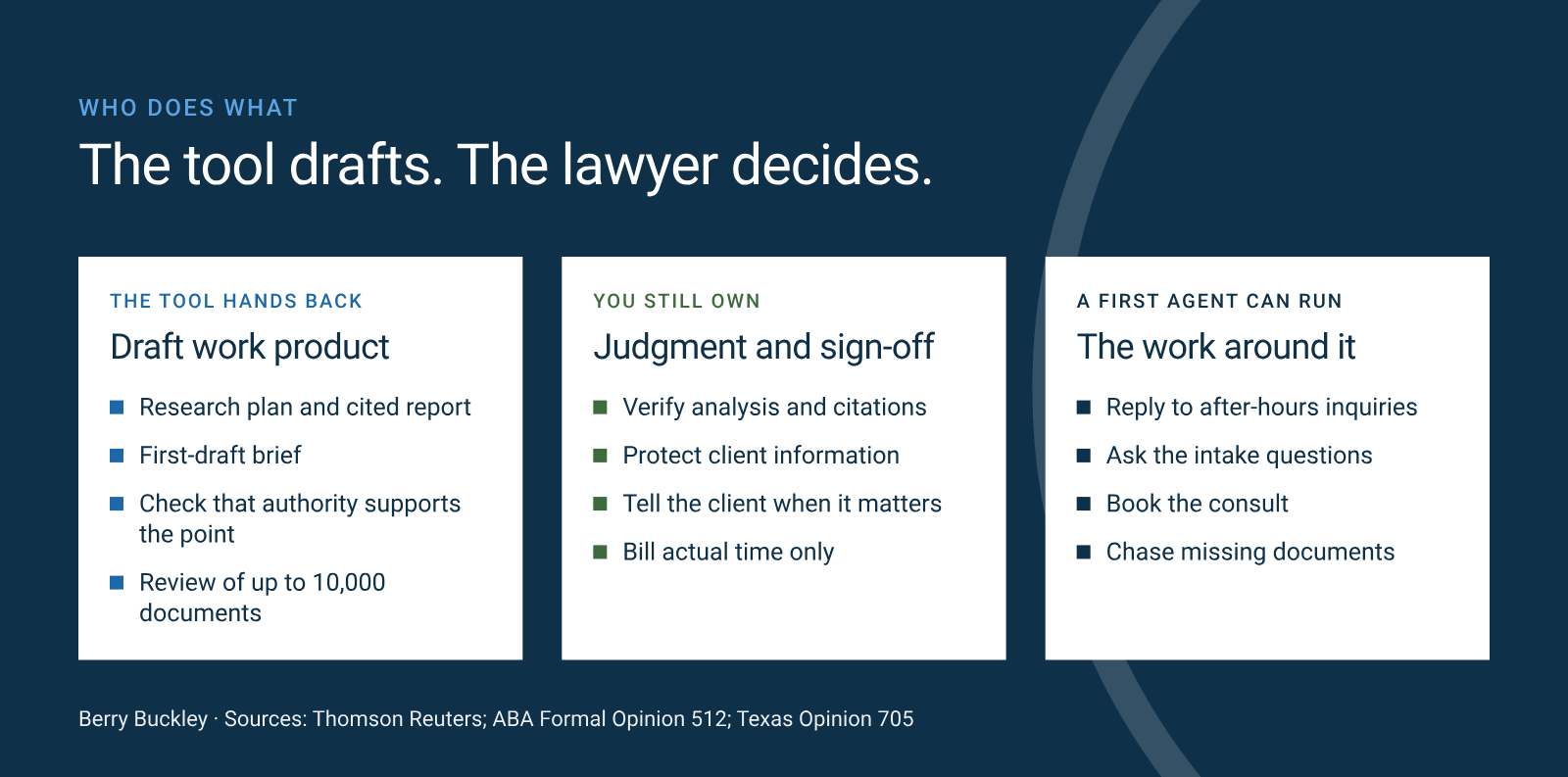
That's where a small firm can put an agent to work without handing over any legal judgment: intake, follow-ups, scheduling and document collection.
The tools above live in research, drafting and review. The work around them runs on email and calendars: the inquiry that arrives at 8 p.m., the intake questions, booking the consult, chasing the signed engagement letter or the client's documents.
That's the work we build first agents for. At Berry Buckley, a first agent takes one of those jobs on the tools your firm already uses. For law firms, that's most often replying to after-hours inquiries, asking the intake questions and booking the consult. It doesn't give legal advice, assess a case or decide whom the firm takes on. Every agent ships with an owner playbook that says what it does on its own, what waits for your approval and what it must never touch.
The same care applies. Opinion 512 notes that prospective clients' information gets similar protection, so an intake agent needs clear limits on what it reads and where that information goes. We don't build legal research tools, and we won't pick one for you.
If you want to know which job in your office is worth handing to an agent first, start with a free First Agent Audit. You'll get a written brief with a recommended next step, or a clear no. Prefer to talk first? Call (972) 362-9235.
Frequently asked questions
Can lawyers use ChatGPT for legal research?
Yes, with care. Neither the ABA nor Texas bans it, but both require you to understand the tool, protect client information and verify the output. Texas advises against entering confidential information unless you're satisfied the tool won't reveal it, or the client has been consulted and consents.
Do I have to tell clients I use AI?
Not always. Under Opinion 512, you must if the client asks, if the engagement terms require it, if client information goes into a self-learning tool, or when the output will influence a significant decision or bears on your fee.
Can I file CoCounsel or Harvey output without checking it?
No. Both vendors design their workflows to end in a lawyer's review, and Opinion 512 requires you to review analysis and citations before submitting to a court. Tools like Deep Research Verify speed up the check. They don't replace it.
Do Dallas and Fort Worth federal courts require AI disclosure?
For briefs, yes. Northern District of Texas Local Civil Rule 7.2(f) requires a first-page disclosure when a brief was prepared using generative AI. Check each judge's standing orders too.
Can I bill for time the AI saved?
No. Hourly billers charge actual time, including prompting and review. Flat fees still have to be reasonable: Opinion 512 says charging the same flat fee when AI makes the work much faster may be unreasonable.
The tools will keep getting better at the draft. The signature line isn't changing.
This article is general information, not legal or ethics advice. Check the rules and orders that apply to your firm and your courts.
Sources
- Thomson Reuters, Thomson Reuters Launches Next Generation of CoCounsel Legal (Aug. 20, 2026)
- Thomson Reuters, What true deep research looks like (Oct. 16, 2026)
- Harvey, Platform overview
- Harvey, Introducing Agent Builder (Mar. 9, 2026)
- Harvey, Run Custom Harvey Agents Directly in Word (Sept. 23, 2026)
- Harvey, The New Harvey for Outlook (Aug. 12, 2026)
- ABA Standing Committee on Ethics and Professional Responsibility, Formal Opinion 512: Generative Artificial Intelligence Tools (July 29, 2024), and ABA announcement
- Professional Ethics Committee for the State Bar of Texas, Opinion 705 (February 2025)
- Mata v. Avianca, Inc., No. 22-cv-1461 (PKC) (S.D.N.Y. June 22, 2023), Opinion and Order on Sanctions
- Magesh et al., Hallucination-Free? Assessing the Reliability of Leading AI Legal Research Tools, Journal of Empirical Legal Studies
- U.S. District Court, Northern District of Texas, Local Civil Rules, LR 7.2(f) (effective Sept. 1, 2026 edition)